
Pad See Ew – the popular Thai stir fried noodles straight from the streets of Thailand made at home! While Pad Thai is sweeter and nuttier, Pad See Ew is salty, balanced with a touch of sour and a wonderful chargrilled flavour which you can create at home!
This is a reader-favourite recipe included by popular demand in my debut cookbook “Dinner”!
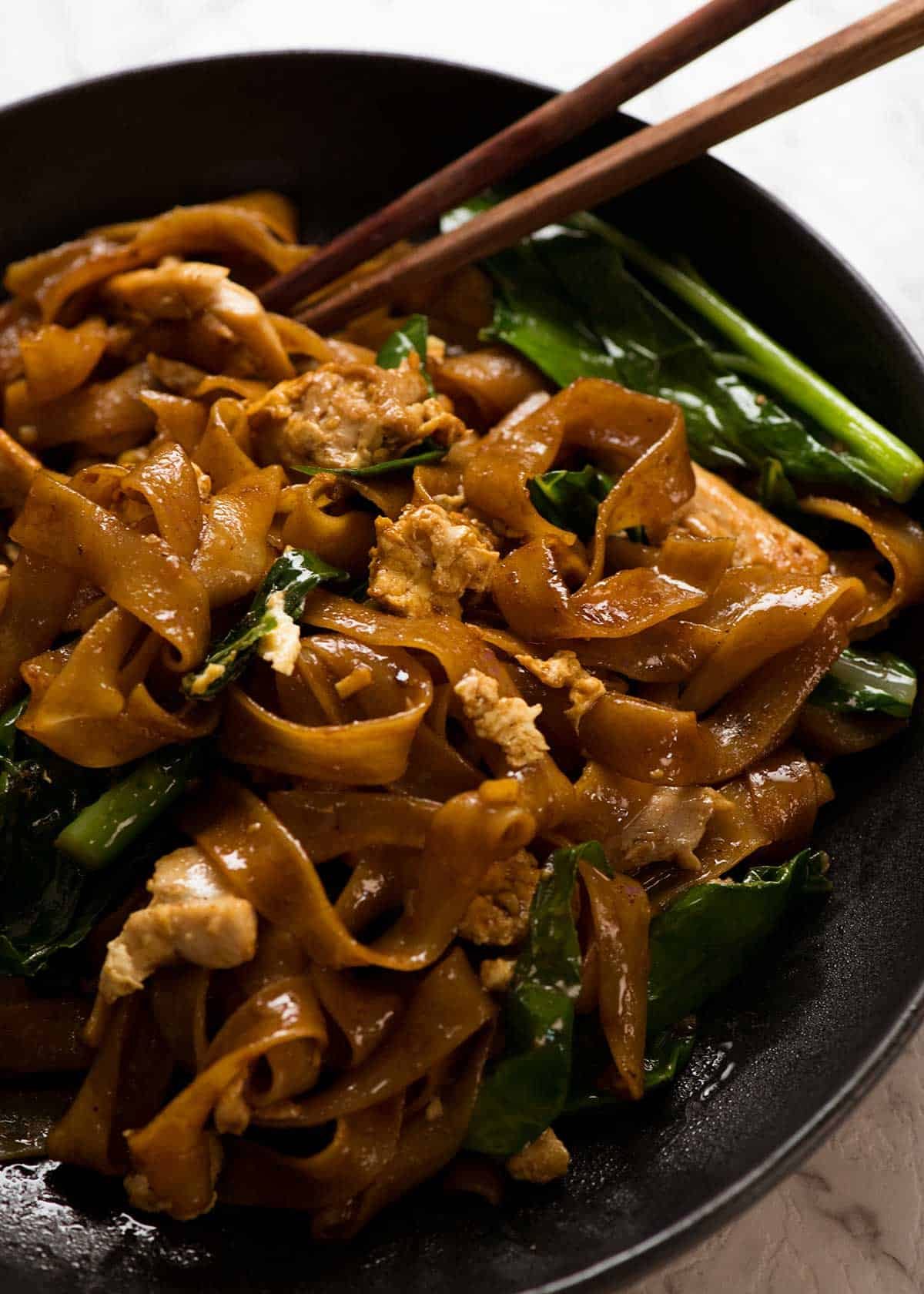
Pad See Ew
Pad See Ew, which means “stir fried soy sauce noodles”, is an extremely popular Thai street food meal and one of the most popular noodles dishes at Thai restaurants here in Australia.
Making a great Pad See Ew at home simply comes down to two things:
The right sauce. Basic recipes online will instruct you to use little more than just soy sauce and sugar. It takes a little more than that!
Caramelising the noodles – Getting a little caramelisation on the noodles makes all the difference between an “ok” and “wow, it’s JUST like you get at restaurants!”.
The trick? Remove the stir fry ingredients. Cook the noodles with sauce separately. Less stuff in the wok (or skillet) = easier to caramelise the noodles. At least, at home. If you’ve got a giant restaurant wok burner, you don’t need to do the noodles separately!
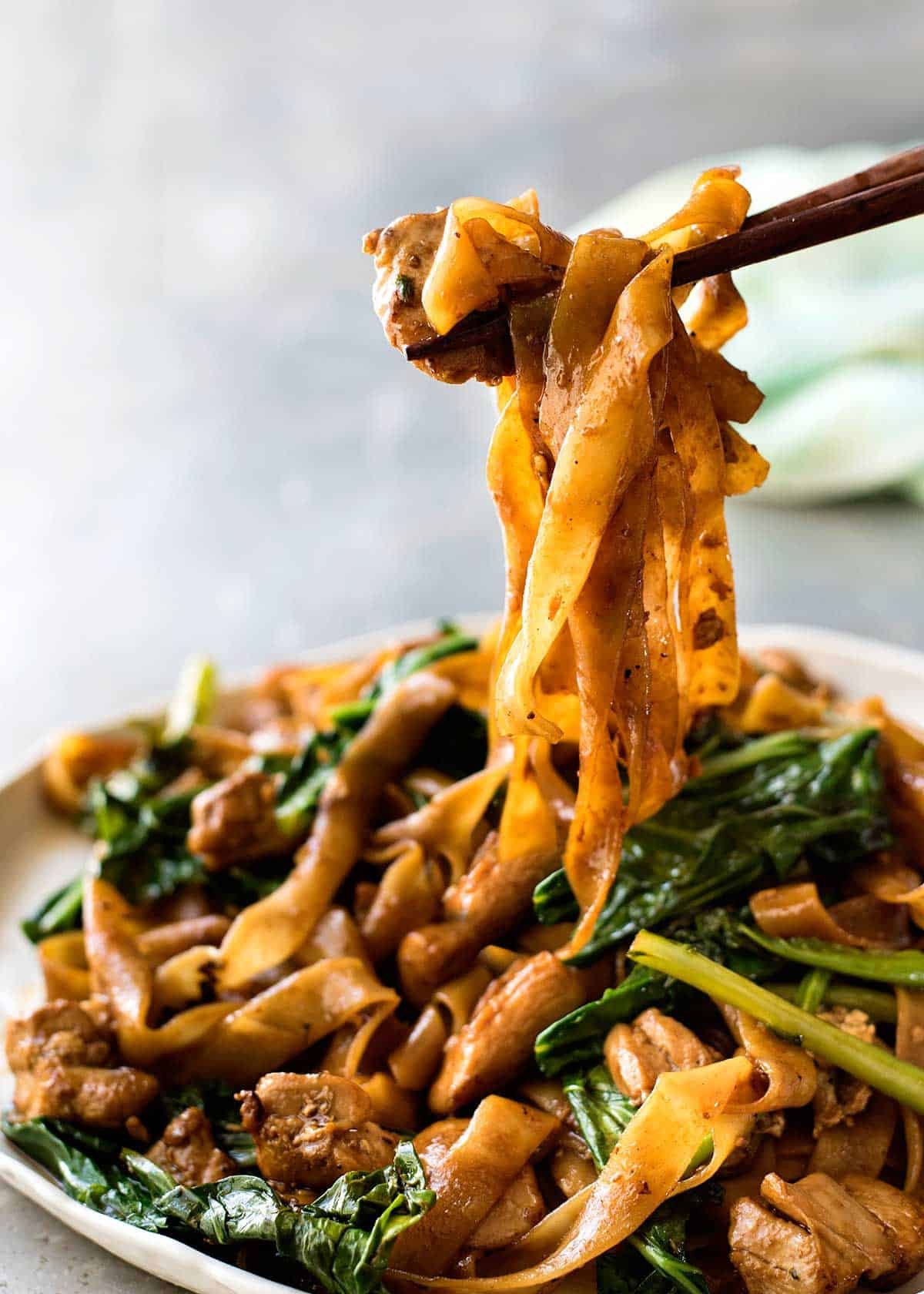
What goes in Pad See Ew
I can’t remember where I originally got the recipe from. Probably from David Thompson, the famous Australian chef who has dedicated his life to mastering the art of Thai cooking. I’ve made it so many times over the years, I can almost make it with my eyes closed. (Not really….but you know what I mean!)
So I had to actually measure the ingredients properly to share the recipe!
1. Pad See Ew Sauce ingredients
Pad See Ew has a sweet-savoury-touch-of-sour flavour, and this is made with a combination of the following ingredients:
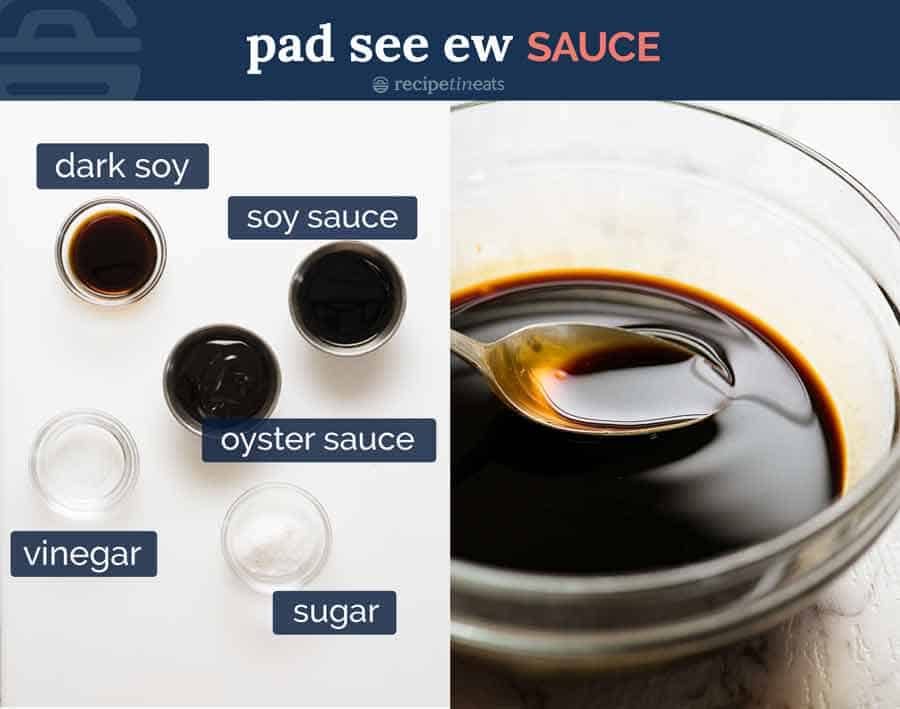
Dark soy sauce – For flavour and staining the noodles a dark brown.
Ordinary or light soy sauce – For seasoning (salt) and a bit of flavour. Most of the flavour comes from the oyster sauce and dark soy sauce. More on different soy sauces and when you can substitute with what in this About Soy Sauces post.
Oyster sauce – Key ingredient, it’s like 10 difference sauces mixed up in one bottle!
Vinegar – To balance the sweet and savoury. Some form of sour is a key ingredient in South East Asian cooking!
Sugar – For sweetness.
2. Pad See Ew ingredients
And here are the other ingredients for Pad See Ew:
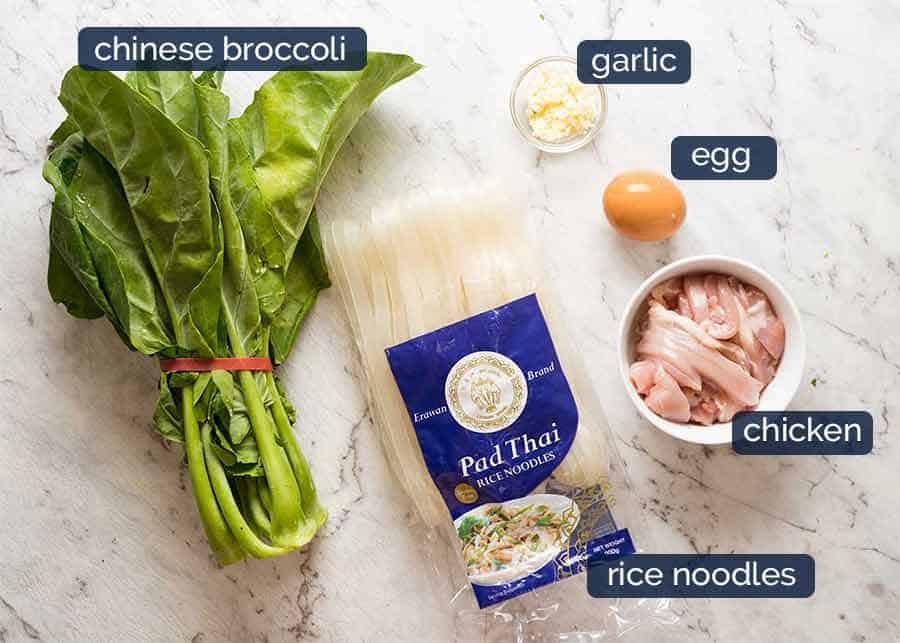
Noodles – Pad See Ew is traditionally made with Sen Yai, which are wide, thin fresh rice noodles that are not easily accessible. Even most Asian stores in Sydney do not sell them – you usually need to go to a Thai grocery store.
So it is perfectly acceptable, and just as delicious, to make them with any wide flat rice noodles. I use dried rice noodles labelled as “Pad Thai” Rice Noodles (pictured below) because they are the widest available at the supermarket.
Once rehydrated, they’re essentially Sen Yai Noodles – just not quite as wide.
Chinese Broccoli / Gai Lan – This is a key authentic ingredient in Pad See Ew. Otherwise known as Gai Lan or Kai lan, it’s leafy and looks quite different to broccoli, but you’ll notice a similarity in the texture of the stems (hence the name).
If you can’t find it, just sub with other Asian greens, or a combination of broccoli or broccolini + spinach.
Chicken and egg – Feel free to use other proteins if you wish. But chicken is by far the most popular.
How to make Thai Stir Fried Noodles
Usually when making stir fried noodles, we toss everything together in one big pan or a wok.
But for Pad See Ew made at home, I do things differently to best replicate a restaurant flavour and minimise noodle breakage:
Cook chicken and vegetables first, then remove
Add noodles and sauce, toss to caramelise (just 15 seconds), then add chicken and vegetables back in.
Reason: A signature flavour in Pad See Ew is the caramelisation of the noodles. Restaurants and street vendors achieve this with super powered gas stoves with fiery heat that you’ll never find in a home kitchen. The only way to replicate that caramelisation on the noodles on a home kitchen stove is to declutter the wok and cook the noodles separately – the noodles will caramelise in 15 seconds.
The other reason is that rice noodles break if you toss them too much. Doing the two-stage toss makes it much easier and faster to disperse the sauce and bring the Pad See Ew together.
Trust me on this point. I’ve made a LOT of Pad See Ew at home in my time, and the two-stage toss it the easiest and most effective technique!
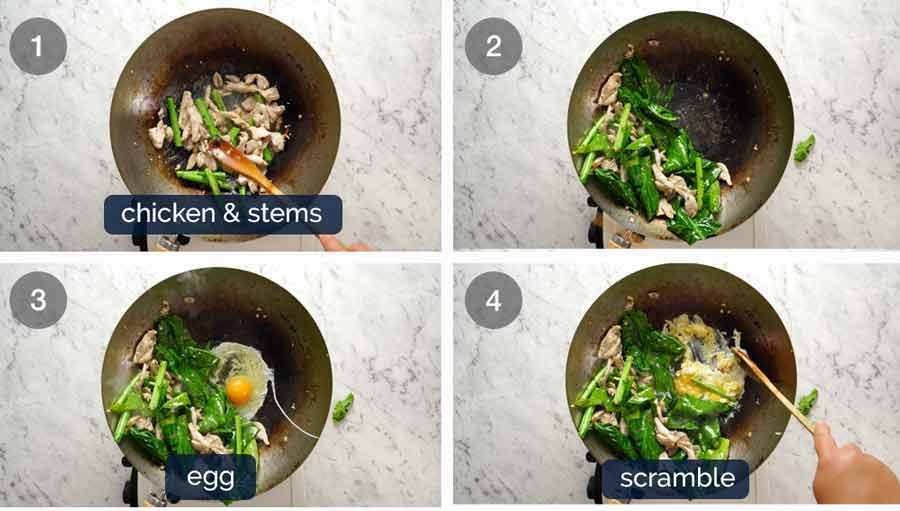
Garlic, chicken and Chinese broccoli STEMS first – Using either a wok or large skillet set over high heat, heat the oil then sauté the garlic until it goes light golden. Add the chicken then once it mostly changes from pink to white, add the Chinese broccoli stems which take longer to cook than the leafy part.
Once the chicken is cooked (it should only take 2 to 3 minutes), toss the Chinese broccoli leaves in and cook for 30 seconds or so just until wilted.
Push everything to the side to make room to scramble the eggs on the side. This is the traditional Thai way of scrambling eggs in Pad See Ew!
Crack egg straight into the wok.
Scramble egg – Then mix to scramble it. Speed is of the essence here – we want scrambled egg not a sunny side up egg!
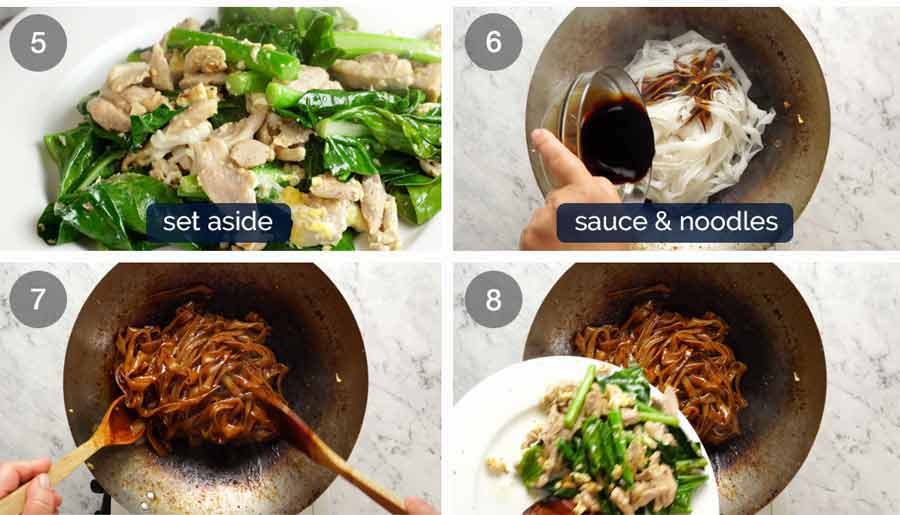
Empty wok – Remove the chicken and vegetables onto plate. As mentioned above, the best way to cook Pad See Ew at home is to cook the noodles separately so we can get some nice caramelisation on them. If we don’t do this, then the noodles just stew instead of caramelising.
Add noodles and sauce into the wok.
Toss quickly for 1 to 1 1/2 minutes until the sauce is dispersed throughout the noodles and you see some caramelisation on the edges.
PRO TIP: You want to be quick here because the longer and more you toss, the more noodle breakage you have. You’ll notice restaurants typically toss the noodles in the wok without using a wooden spoon or other tool for stirring – this too helps to minimise noodle breakage.
A note on Noodle Breakage – That said, you WILL get some noodle breakage, and that is normal / perfectly acceptable. Ever notice how the wide, flat noodles in Pad See Ew served at Thai restaurants are not long strands? That’s just the way it is. In fact, traditionally, Pad See Ew is served in Thailand with a FORK or spoon instead of noodles for ease of eating.
Add chicken and veg back in – Once the noodles are caramelised, add the chicken and vegetables back in. Give it a quick toss just to disperse, then serve!
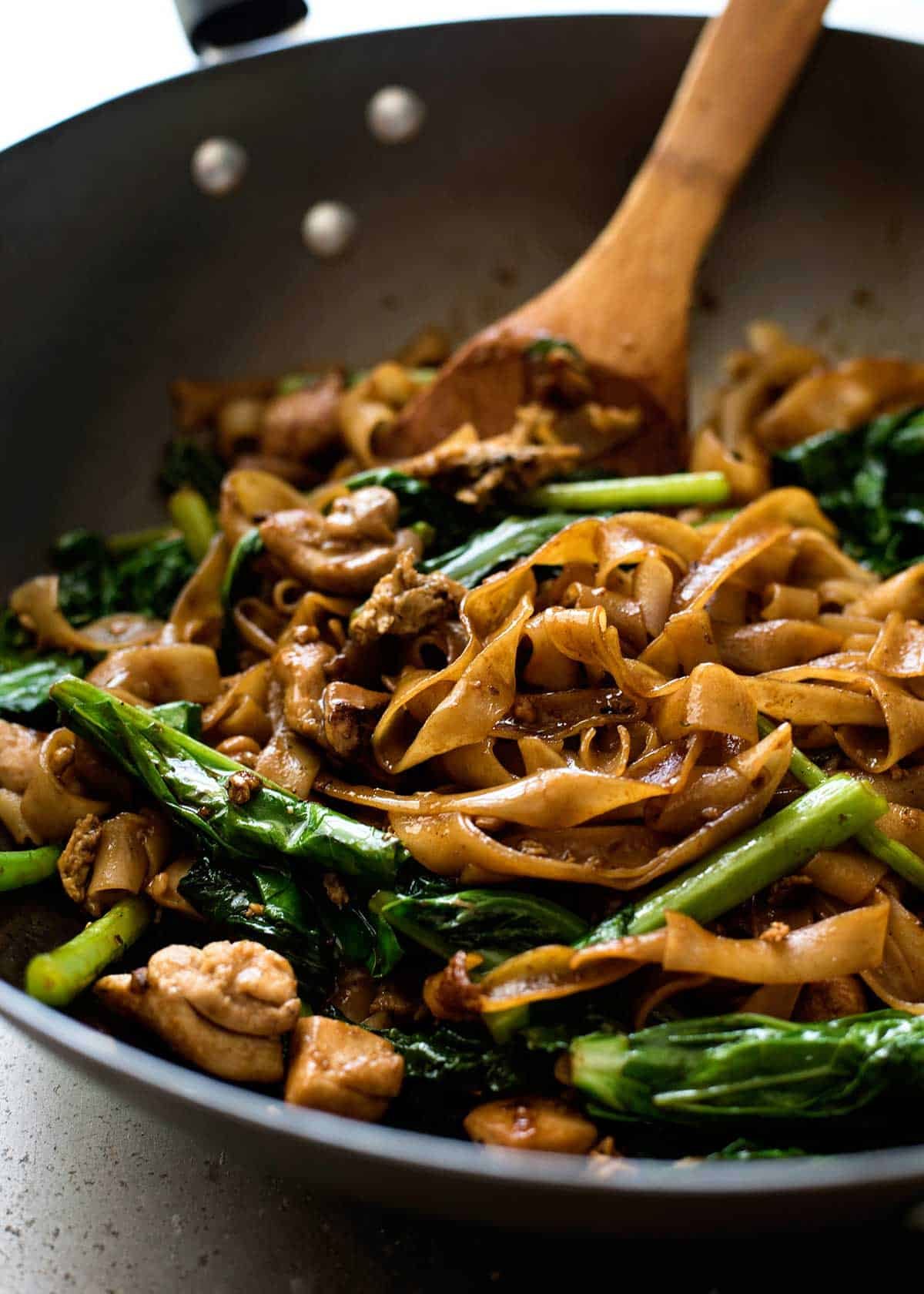
As with all stir fries, once you start cooking, it moves very fast! So have everything prepared and ready to throw into the wok because there’s not time to be scrambling around the kitchen!
If you want to add a fresh side, try this Asian Slaw – it’s a great all rounder that goes with all Asian foods. – Nagi x
Watch how to make it
This recipe features in my debut cookbook Dinner. The book is mostly new recipes, but this is a reader favourite included by popular demand!
Hungry for more? Subscribe to my newsletter and follow along on Facebook, Pinterest and Instagram for all of the latest updates.
Pad See Ew – Thai Stir Fried Noodles
Ingredients
Noodles
- 200g / 7 oz dried wide rice stick noodles , or 15 oz / 450g fresh wide flat rice noodles (Sen Yai) (Note 1)
Sauce
- 2 tsp dark soy sauce (Note 2)
- 1 1/2 tbsp oyster sauce
- 1 tbsp light soy sauce (or all purpose, Note 3)
- 2 tsp white vinegar (plain white vinegar)
- 2 tsp sugar (any type)
Stir Fry
- 3 tbsp peanut or vegetable oil , separated
- 2 cloves garlic cloves, very finely chopped
- 1 cup / 150g / 5oz chicken thighs (boneless, skinless), sliced (Note 4)
- 1 large egg
- 4 stems Chinese broccoli (Note 5)
Instructions
Preparation:
- Chinese Broccoli – trim ends, cut into 7.5cm/3" pieces. Separate leaves from stems. Cut thick stems in half vertically so they're no wider than 0.8cm / 0.3" thick.
- Noodles – Prepare according to packet directions and drain. Time it so they’re cooked just before using – do not leave cooked rice noodles lying around, they break in the wok.
- Sauce – Mix ingredients until sugar dissolves.
Cooking:
- Heat oil: Heat 1 tbsp oil in a very large heavy based skillet or wok over high heat.
- Cook garlic and chicken: Add garlic, cook 15 seconds. Add chicken, cook until it mostly changes from pink to white.
- Chinese broccoli STEMS: Add Chinese broccoli stems, cook until chicken is almost cooked through.
- Chinese broccoli LEAVES: Add Chinese broccoli leaves, cook until just wilted.
- Scramble egg: Push everything to one side, crack egg in and scramble.
- REMOVE chicken from wok: Remove everything in the wok onto a plate (scrape wok clean).
- Caramelise noodles: Return wok to stove, heat 2 tbsp oil over high heat until it starts smoking (HOT is key!). Add noodles and Sauce. Toss as few times as possible to disperse Sauce and make edges of noodles caramelise – about 1 to 1 1/2 minutes.
- Add chicken back in: Quickly add chicken and veg back in, and toss to disperse. Serve immediately!
Recipe Notes:
Nutrition Information:
Originally published 2014, updated 2016. Updated over the course of the years with improved photos, the addition of ingredients and process photos as well as a recipe video. Recipe also updated with a more effective cooking method – cooking the ingredients in two batches. No change to ingredients, but yields a better caramelisation and easier to cook – read in post for explanation.
MORE THAI TAKEOUT FAVOURITES
Love noodles? Me too! See my entire Noodle recipes collection.
Life of Dozer
When Dozer ate a VERY spicy piece of chilli biltong!!

I checked on the packaging, and there isn’t a shelf-life date, or any date for that matter on it. Oh well, guess that means I’ll have to make this tonight vs. over the weekend! Yaye for me 😉
Yep, not a bad problem to have!! 🙂
I made this recipe last week with fresh chow fun noodles, and it was DEElicious! I ate three bowls , one right after the other. I have to admit, next time I will make a little more sauce, and cut back a bit on the sugar, but I LOVED this recipe so much, I’m making it again this week!
I just saw your posting of the slow cooked Shredded Beef Ragu Pasta, and I’m going to try that this weekend as well. Thank you so much for sharing AND for the quick replies to my questions!!
The thought of you eating 3 bowls in a bowl had me giggling because it is JUST like me! I get a tiny rice bowl and say to myself “OK, you have to cut back on carbs so just a SMALL serving”…then I go back for seconds…then thirds….so the aggregate of the three bowls would actually be one GIANT serving.
I am glad you enjoyed it! And that you plan to adjust it to your taste 🙂 You must really have a savoury palette as I don’t have a very sweet tooth so my dishes tend to be less sweet than most recipes 🙂 Thank you for coming back to share your thoughts and I hope you try the ragu! It really is soooo yummy…I could eat it everyday! 🙂
I’ve eaten Pad See Ew twice in the last week, so I decided to try to make it at home. I had trouble finding the rreice noodels at the Asian store, and the clerk recomended I use the fresh chow fun noodles (Hu Tieu), so I bought them. Will this work, and if so, how or what do I need to do to them to prepairs for the dish, if anything? Also, how long will the fresh noodles keep in fridge? I can’t wait to try this over the weekend!!
Hi Liz! Any noodle stir fry is even better made with fresh noodles! By using fresh noodles, you don’t need to rehydrate them like you do with dried noodles so you save yourself that step. Just add it to the wok as per the recipe!
Unfortunately I can’t tell you how long the shelf life of the noodles are, it depends on brand to brand. Did you check the packet? In Australia, everything has to have a “use by” date on it. 🙂
My husband and I LOVED this. Like, really LOVED this! The only difference I’ll make is I’ll double the veggies, add in some thin sliced carrot and possibly red pepper and double the sauce. I couldn’t find the dark sweet soy sauce, but I did find a “Thai Flavoured” Soy Sauce and used that instead and added a small spoon of dark brown sugar.
I usually rotate our meals so we go at least two weeks (usually three) without meal repeats. But we’re having this again not even a week later!
Thanks so much for coming back to leave your feedback Jennifer! I am so SO glad you enjoyed this, I love Pad See Ew so much! I often increase the veggies in this too, sometimes I leave out the chicken or substitute with tofu. That’s the great thing about stir fries, you have such freedom to change it up to your taste! Thanks again Jennifer! 🙂
Just came back to say we’ll be having this for the third time in three weeks. This is definitely our new fave!
Ha ha!! That could be ME talking! I have this way too often! 🙂
Best recipe! I tried another ‘authentic’ pad see ew recipe but it was dry and bland. This one tastes like the ones from the restaurant . Veggies and noodles were glossy and tasty! Thanks Nagi for sharing
I’m so glad you enjoyed it Mirta! Thanks for coming back to share your thoughts!
what brand of oyster sauce would you recommend to use?
Hi Afia! I find Oyster Sauce is fairly good no matter what brand you use. I do tend to try to use an “Asian” brand that I find at supermarkets – like Ayam or Lee Kum Kee, rather than the no frills / no brand ones. 🙂 Hope that helps! PS I’m in Australia….not sure if you have those brands where you are 🙂
Nagi! This is one of my favorite dishes at Thai restaurants!!! Yay! now I can make it!
Oh yay!! Hope you like it 🙂
This is my all-time favorite Thai dish! I’ve tried making it before but it was disappointing and way too “eggy” – this recipe looks just right. Just have one question about the dry rice noodles… whenever I just soak them in boiling water (as directed) they’re always undercooked! (Next time, I’ll try your suggestion about adding water to the pan and letting it boil – although I don’t like my veggies overcooked.) Do you ever recommend cooking them like you’d cook pasta??
Hi Tara! Preparation of rice stick noodles depends on the brand 🙂 I sometimes get a brand where I can soak them in boiling water and other brands say to boil it like pasta just for a few minutes. To use the method adding water to the pan, you only add a touch so you aren’t really boiling them, just giving the noodles a chance to absorb more water so your vegetables won’t end up boiled 🙂 It’s kinda like when you add a splash of pasta water to emulsify the pasta and finish cooking it. You only need a splash – about 1/4 cup at most I’d say. Hope that helps!
Nagi, I just found this gem on your recipe list. I get this dish a lot at Thai restaurants, and it never disappoints. I’ll let you know how it goes when I make it!
Thanks Sarah! Love to hear what you think!!
Found the recipe, made it for dinner tonight… and WOW! Amazing! Simple, easy to make and fantastic deep flavor. We added some red pepper sauce and a few red pepper flakes (we love it spicy) and this worked amazingly well! Thank you, thank you, thank you!
That’s so great Mikey! I’m so glad you enjoyed it! You’ve made my morning, reading this enthusiastic comment! 🙂 Thank you for letting me know you enjoyed it!
This looks amazing! Is there anything I can substitute for the oyster sauce?
Hi Faith – that’s a tough one! I’m sorry but I can’t think of a good substitute for oyster sauce, I even googled it 🙂 But when I make a vegan/vegetarian version of this, I substitute the oyster sauce with hoisin sauce. It doesn’t taste quite the same, mainly because of the five spice flavour of hoisin sauce, but it is still absolutely delicious!
Wow, look so yummy, I’m going to shop at Asian shop today and I’ll buy rice sticks noodles to make this recipe, thanks for sharing Nagi.
Wow, I made this last night and it was super!!!
I’m so glad you enjoyed it Katie! Makes me very happy to hear that! 🙂
I absolutely love Pad See Ew! Best Thai dish ever!
This looks really quick and easy to make. Can’t wait to try and make this dish.
Wow, looks great! I love Thai food.
Love it.
Great recipe.
This is my favorite Thai dish. I made it tonight and the sauce wasn’t flavorful enough. It was good but missing something. I wasn’t able to find dark week soy sauce and ended up using half dark and half sweet in the recipe. Wonder if that is the reason for the taste not quite there. Will keep working with it. It’s the closest I’ve come to the perfect recipe.
Hi Joanna – that would definitely affect the flavour because sweet dark soy sauce is thicker and sweeter than normal soy sauce so it adds much more flavour that the same quantity of ordinary soy sauce. Also, this dish in Thai restaurants in western countries is typically much saucier and oilier than the real Thai street food version so if you want to achieve the Western restaurant “saucier” style, increase the sauce ingredients by 50% (don’t double it, it will be far too salty) and add 1 extra tbsp of oil and this will also increase the strength of the flavour. Hope that’s helpful!
What do you if you put the noodles in the pan and they are still undercooked? Darn it? Threw it in the pan without checking if it was fully cooked.
That’s ok! It can be salvaged – all you do is add 1/2 cup of water (preferably boiling) in the pan and basically “boil” the noodles in the pan until they are cooked through. If they are really undercooked, just keep adding a bit of extra water at a time – rice noodles do not take long to cook so it shouldn’t need much.
That pic makes me want to dive into that plate of noodles. It sounds a lot like a Thai version of Char Kway Teow which is charred flat noodles with various stuff. Looks fantastic! I always love the combo of oyster, thin and thick soy sauces.
Oh yum I LOVE Char Kway Teow! have you got a recipe on your site?? Popping over to check!
I wish! It’s one of those recipes I consider to be deceptively simple, it looks simple but it takes mastery to come out right. So I haven’t touched masterpiece recipes like that and Assam Laksa till I get it right!
Laksa from scratch is hard…..from what I’ve been able to find out, even in asia most people use store bought paste as the base…
The only times I’ve eaten this dish, it was too sweet. I will try out this recipe since it appears to be more savory than those I’ve tried in the past. Thank you for sharing this recipe and tips.
I am more of a savoury than sweet person so hopefully you will find this not too sweet for you! I agree that many of them can be too sweet. To balance it to your taste, when you mix up the sauce in a bowl, just dip your finger in before adding the sugar and if it’s sweet enough for you then simply don’t add the sugar. Hope you enjoy it! Thanks for dropping by. 🙂